Wednesday, March 21, 2012

Peace without coffee


Now that's advertising!
My daily haunt is a little coffeehouse smack dab in the middle of my college town. The building is made to replicate the cafes of old, with giant brass espresso mechanisms, cracked bricks, old bicycles, and creaky wooden floors. Like most folks, the fragrant aromas of coffee and chai draw me from the “world outside,” in which I live life as a disheveled undergrad, to the world of “coffeehouse,” in which I am instantaneously at ease.

I think this is an atmosphere of peace. Everything, from the consciously chosen mood music, to the continual bombardment of herbal fragrances on our persons brings some semblance of calmness to each of our senses. It is all meant to produce a micro-environment of peace so as to draw our busyness out of life… and maybe turn a profit.

It’s funny how we as people can invent our own version of pseudo-peace. We crave this quiet environment now more than many other sources of sustenance. Life is loud, and our worries are urgent. To cloister ourselves in a giant coffee box from the constant upheavals life tends to throw at us is now a viable business model.

Peace is commercial. Peace is consumable. Peace is now “supply and demand.”

Don’t get me wrong, I love the social possibilities coffee joints offer to us as communal beings. A warm drink and a strong sense of comfort have been of utmost importance in many powerful interactions, revelations, and epitomes in this short, idealistic life of mine. I’m not attacking the coffeehouse industry itself, nor am I leveling anything at any individual shop. Instead, I feel it important to examine why I, and so many others, manufacture peace as a commodity.

There is no command more repetitive in Scripture than “do not fear.” In fact, those exact words are used nearly 365 times throughout both Testaments. For the Christ-inclined, life is meant to be in a constant state of anti-worry. Lack of restraint gives birth to life in its fullest, most meaningful form. Faith in God and trust in humanity save us from fear.

I’m sad that I forget this so often. I’m sad my consumptive, anesthetized culture draws me away from the satisfaction and contentment that is produced from living for others. And, most disappointing of all, I’m sad we settle for peace in consciously constructed environments.

Find peace in who you are, and in who God made you to be. It’s never bad to be active, but life isn’t about doing every single task in existence you can before you die. It is instead about doing the small things for others that build upon themselves until they crash into society as a giant wave of contagious love. There you will find peace everywhere you go. You no longer have to rely solely on a coffeehouse for your soul’s refreshment.

Stupefied at how much he spends on coffee,
Troy

Saturday, March 17, 2012

No Small Dreams


He dreamt big enough to write a book...
so that I might rip the photo off for my blog
Am I the only one who envies those select few who, no matter what the circumstances, always dream big? Or more simply, does anybody else envy the work ethic required to continuously strive for leaving this world a better place than when one enters it? This rare talent propels the world into meaning and beautiful stories. My dreams seem so sad and small when compared to those dreamers who refuse to cease dreaming.

I have a friend who dreams big. He possesses a plethora of V-necks and wears cardigans during the summer… definitely one hip dude. More striking than his wardrobe, however, is his desire to bring meaning to others in big ways, and, as a consequence, find meaning in his own life. He wants to open a coffeehouse in a community struggling with… well, community. He dreams of mentoring youths through corporate worship and informal teaching settings so as to raise up a loving Church. And, most powerful of all, he dreams of travelling to all the world’s countries with a camera to interview and document religious minorities. This guy dreams big. I can only imagine the process of a mind in constant search for ways to bring meaning to the lives of others. This dude is the real deal!

Johann Wolfgang von Goethe best illustrated the importance of dreams when he suggested all should “dream no small dreams, for they have no power to move the hearts of men.” Goethe understood how reaching the hearts and passions of those around him was of utmost importance, and that none can truly bring others into a place of passion and drive without a life-changing, terrifyingly risky dream. These dreams don’t bore us into the comfortable stupor that keeps the majority of us desensitized from the plights of others. Real change, according to Goethe, can only come about when we refuse to fear risk and dream big enough to cause excitement in others.

When we speak of dreams, we must realize that the dreams that bring true meaning are never fully realized. The profoundly enormous dreams are the ones that will be set into motion so as to last far beyond our own lives. When we dream big others will join in that dream, and passion for changing the world will grow exponentially. I pray that each of us grow into uninhibited dreamers who risk all for the betterment of those we can serve, and, in doing so, we live lives of complete fulfillment. May you never fear risk, nor allow society to numb you to the plight of the oppressed.

May your dreams be oases of life!
Troy

Friday, March 16, 2012

It's all about the "Me"

It's not all about you! It's all about Apple... right?
If reading this blog has left the reader confused as to how I see the world, I think clarification may be required to maximize understanding. I am comparative in nature. On some days, I see the potential good within the Church, yet am also quick to see the evil and the misguidedness of the modern faith in the very same context. Or what I should do, but, as is nearly always the case, what I actually do. "Hows" and "How-Nots" have long been my modus operandi in regards to expressing my world views. In pursuing this method for self-expression, I have developed two habits that may be categorized as both healthy and unhealthy.


1.) I like reading lists.
2.) I like compiling lists of my own.

Paul is one of the most profound list-makers of all time. The NT is littered with Paul's frank and explicit lists. Think fruits of the Spirit, armor of God, spiritual gifts, etc... What many are also quick to notice is how Paul is just as plain in listing the things that God hates. These lists tend to run the same rhythm from letter to letter and serve to communicate the stupid ways that Paul had seen many lead their lives. Practices like debauchery, drunkenness, sexual immorality, and idolatry were common practices in the Greco-Roman world (... or America) that Paul sought to inject faith and love into. I tend to communicate in lists like this as well (see nearly every last paragraph in nearly every post on this site). But I think, deep down, these lists hint at something that is ungodly:

I tend to write for attention, just as almost all of my actions seek attention.

Striving for community is not a bad thing. We were created for it! But one of Paul's common evils listed is "selfish ambition." Selfish ambition drives us in nearly everything we do (I can't speak for all of you, but I CAN speak for many). Lists are used to compare the things we see and do, and so I use lists to compare my thoughts or beliefs to others' viewpoints. But over time, this has devolved in my life to the point where now I compare myself to other people constantly. Ambition drives me to be above, better, far more "awesome" than those around me... and that is a terrible way to walk.

To combat selfish ambition, one needs to hear Paul speak of freedom in Galatians 5: "1 It is for freedom that Christ has set us free. Stand firm, then, and do not let yourselves be burdened again by a yoke of slavery." and "13 You, my brothers, were called to be free. But do not use your freedom to indulge the sinful nature; rather, serve one another in love." Selfish desires for attention, sugar coated as "selfish ambition," is a yoke that serves to blind us from serving others. We are called to love, which requires empathy. The development of empathy can only come from serving others (especially when we would rather do anything else). 


Paul knows that Jesus came to liberate through servitude via love. If we want to live (and love) as Jesus did, we need to learn to serve others in everything. In doing so, we will live life to the fullest in genuine community, and our selfish ambitions will become instead the realizations of something meaningful. No longer will we compare ourselves with others for our own sense of self identity. Instead, our Christ-like walk will lead us into the identities we were truly meant to own. 


I leave you with Paul:


"2 Carry each other’s burdens, and in this way you will fulfill the law of Christ. 3 If anyone thinks he is something when he is nothing, he deceives himself. 4 Each one should test his own actions. Then he can take pride in himself, without comparing himself to somebody else, 5 for each one should carry his own load." - Galatians 6:2-5


Would love to hear your freedom stories!
Troy

Monday, November 14, 2011

Wall Street's got nothin' on me...

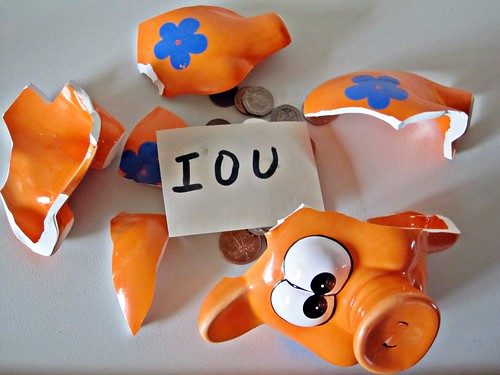
It has... coins for organs?
Does anybody else out there have a guilty pleasure blog? You know, that one piece of perpetually updated internet writing that shouldn't be enjoyable, but it claws at your brain without your permission? Huffington Post's blog section is like that for me. I enjoy the news they offer, yes, but I've always held the belief that commentary and opinion on a news site should be avoided in general. But on HuffPo... well, maybe I can fudge a little bit on my conviction.

I read an article today by Leo W. Gerard entitled "Crash Tax: Wall Street Reparations." Mr. Gerard is the president of United Steelworkers, a sizable entity in the manufacturing sector. In his article, Mr. Gerard argues for a tax on financial transactions by businesses so as to mitigate the lack of fair tax structure when it comes to taxing large financial institutions. His point, of course, being that Wall Street is guilty for the financial instability that we find ourselves in currently. As the neo-communitarian hippie in the room, normally I'd agree with this sort of sentiment (FIGHT THE NAZI-FASCIST-TOTAL-LAMEWADS!). But for some reason, this particular article caused me to approach the financial bubble crisis in a different light.

I don't blame Wall Street. I don't blame Congress. I don't blame President Obama. I blame me. And I blame my friends. And I blame the majority of the American citizenry.

70% of the American economic structure is consumer-based. That means that the majority of all the money that flows into the monetary system is spent in the consumption of... well, for the most part, it's crap. Think about any effective advertising campaign. "Buy our product" doesn't sell goods. "Buy our product so that your family/sex life is pristine, you look cooler than your neighbor, and it goes fast" seems to be a more readily acceptable marketing gimmick.

The "American Dream," simply stated, is a house, a nice car, and a better collection of doohickery than one's own neighbor. Honor seems to be a main goal, or at least some degree of social recognition. With wage decreases being a constant in America since the 60s, Americans have had to find a new way to maintain their status. If wages can no longer support the consumptive behaviors necessary to maintain the "American Dream," then we turn to borrowing money. The banks are our friends! However, when it all doesn't go according to plan and we rack up massive amounts of debt, then the loaner becomes the evilest of evil.

Oh, sure there was predatory lending throughout the late 90s and early 2000s. And there was a lack of regulation within the financial sector as it rapidly sold the lives and well-being of millions of citizens in the forms of CDOs and unstable assets. And yes, the CEOs of these companies took home huge bonuses whilst they torched the totality of the American economy. But I don't blame them. Who wouldn't grow greedy with that sort of access to easy money? No, I blame the emotionally-driven consumptive mindset of the American citizenry.

Why do you want money? Is it to buy a new car? Or a new coat? I'm not judging, don't get me wrong. I'm just as guilty! But at the same time, I pray that we all become aware of our own mindset when purchasing things. Be aware of the fact that consuming just to look good or be better than others is rampant in our society as a whole. We are driven by emotions and the want to be worth something in others' eyes. Pandering to that is good advertising. I urge you to examine your purchasing patterns and be aware of the consequences of a country of over 300 million people buying products to feel better about themselves.

Part 2 to come,
Troy

Monday, November 7, 2011

Why it's worth stopping the act

It's Heaven... twice!
So... the Goffman post was a bit of a change of pace. I acknowledge that not all of my readers are quite as fascinated with cold, cynical sociologists as I am. Who wouldn't draw all sorts of interest from moral functionalist social theory? Ridiculous! But there WAS actually a point in posting it.

I can't help but think about my interactions with others. Sometimes being completely genuine is difficult because the totality of myself seems dreadfully boring. We each have personal reputations to maintain. Or to build. Or to hope to embody someday. And there's more to our social wants than just a reputation. We want to be loved dearly by others, to know that we are of worth in others' eyes.

To be called for coffee. That's what we want at our deepest level. Maybe not coffee, but to be called for something. It's nice to call others, of course, because any opportunity to share in a friend's company is a beautiful thing. But sometimes a person gets fed up with calling. Maybe he/she wants to be called and thought of. All of us share a desire to be worth another person's thought. That is the deepest need that God has instilled within each and every one of us as communal beings.

So I act. I wear a facade worthy of Shakespearian recognition so as to impress others, using demeanor rituals (BAM! Score one for Goffman!) to try to show how worthy I am of attention. If I am in a crowd of fellow outdoorsmen/women, I loudly proclaim my achievements and latest pieces of outdoor finery/junk. Or in the presence of musicians, you'd think I was a Grammy winner, with my ceaseless boasting and putting down of others' music. But there is one thing that I am learning, with a large degree of difficulty: Trying to show my own worthiness does nothing for my desire for the love of others.

It's in the other type of ritual Goffman postulated, the deference ritual, that we come to satisfy the need for others' respect and care. To review, deference rituals are acts in which we exhibit our respect (or lack thereof) for another person. In respecting others, in loving others, in being willing to sacrifice without expectation of payment, that is where we find the environment in which we can drop the act. If you want others to include you, call them first. And keep doing it. In giving your time, ear, and love to others, you will in turn be loved, even if it takes a long time to feel the results.

I can't say I've mastered this. In reality, I struggle to remember this in my daily interactions. In fact, I am in a near 100% state of not remembering it every single day. And so I pass on to you the opportunity to think about your own personal interactions. Take a peek at my post on Goffman. If reading this post first helps you make sense of it, then feel free to utilize it. But it is worth questioning and praying about how we treat others. "Do unto others as you would have them do unto you," is a sequential process: If you want the love of others, do unto them first. The rest will take care of itself.

Turning a cynic into a "rock on, man!"
Troy

Wednesday, November 2, 2011

Society is a REALLY huge play

Goffman is not amused...
I've been up to some fascinating research lately on morality, ritual, and socialization in religion. One of my favorite sociologists, Erving Goffman, has some remarkably original insights into behavior and how different people are taught to react to situations. I would kind of dig sharing some of that with you so that each of you can maybe approach situations with new mindsets.

To Goffman, mankind is in a constant state of performance. This idea, called the Dramaturgical Analogy, presents people in a new light, namely to portray them in the guise of an actor. A good actor must be flexible (like Sean Connery or William Shatner... right?) to ever succeed in the world of acting. Goffman sees all people, or at least the ones who are socially competent, as multifaceted actors. Imagine! How would people react if you treated complete strangers as you do your spouse? Creepy, right? That, according to Goffman, is one of many reasons that each person needs multiple versions of themselves that they portray to others.

So then are we individuals, with a core concept of who we are? Are people truly independent and different from each other? According to Goffman, we crave social acceptance more than anything else. To gain acceptance, we become as actors and fulfill multiple roles. All actors are each made up of "selves," or instantly accessible personalities. Why plural? Because Goffman sees people as constantly changing these selves, depending on situations. Previous experience with a situation, mass media, or family tell us how to deal with a given scenario, and thus we have multiple reaction indoctrinated into us from multiple sources. When something happens, with lightning speed, we react in a way that is familiar to us. By doing this, we manipulate the outcome of an event. An example would be if a total stranger bumped into you on the street and proceeded to blast a juicy loogie all over your face. Gross! But why is it gross? Simply put, because we've been told, through other people or media, that loogies are gross! So your response, of utter disgust, is a self that has been developed out of previous examples as portrayed in mass media or culture.

In purposefully trying to manipulate a situation to our benefit, we create a new self that is separate from the self that we use elsewhere. When we have to purposefully maintain a self, we are (to use another stage analogy) in the Front. The Front are the environments that we get ourselves into that require us to maintain a self that is separate from the self in the Backstage, or environment where we are most comfortable, such as at home. Because culture as a whole teaches most people the same way to react to most situations, responses go from being completely instinctual to purposeful, structured ritual. Society is basically a fancy word for ritualized responses to events in which we are in constant process of creating and changing between multiple selves in the Front.

The two kinds of ritualized social interaction that we contribute to are demeanor rituals and deference rituals. Demeanor rituals are the things we do to show others that we are worthy of their attention or respect. Deference rituals are the ways in which we show our respect (or lack thereof) for another person. By mastering a balance between these two types of ritualized interactions, one can effectively master one's social environment. The socialization, or influence of our upbringing and past experiences,  of how we behave in the Front are a direct influence on the level of demeanor and deference that we show to others in a social situation. Therefore, we can see that most socially acceptable people are those that have taken the programmed responses that they have become familiar with and have learned to apply those in proper amounts of demeanor and deference behaviors with other people.

This fascinates me to no end! So if this isn't your bag, sorry about that. But I do urge you to start looking at your interactions with honesty. Are we always acting? Is there really an "I" when I think of myself? It's interesting introspection, for sure. I, for one, kind of dig the idea of not being completely socially acceptable :) Christ kind of turns that on its head. Maybe I'm just crazy!

Eluding cynicism... barely,
Troy

Wednesday, October 26, 2011

A life well lived

"Hey, look! A hole! Let's jump in it!"
How one's response should always be
in the presence of a gaping chasm.
Just about everything I've ever needed in my life has fallen in to my lap. When I wanted a job, one would show up within my community of acquaintances. Or I'd stumble into a place in a suit and be rewarded with employment. Should I want a new instrument, one just happens to be going for the right price somewhere nearby (unless it has the word "Fender" attached to it). Cars, activities, food, and housing situations (just to name a few) have seemingly been effortless issues for me.

I am lucky. I am blessed.

I have fairly recently become well acquainted with a few fellow college students who weren't born with this "luck gene" (or, to put it bluntly, without a surplus of money). It is somewhat shocking to learn that every person in the world doesn't have a background in privilege. These students have been hungry, tired, penniless, without transportation, and without employment opportunities. Difficulties have been the norm for them.

And yet they are joyful. They spew joy like a limitless reservoir during flood season. And I envy that from time to time.

It is truly refreshing to know the presence of those who have their work ethic to thank for their joy. Not just happiness, but pure joy and a meaningfulness that speaks volumes through the acts of life. My pessimistic, far too privileged self would do well to emulate their work ethic. My ultimate failure, at least in my own eyes, is in my laziness.

I'm sure many of you can relate. Contentment is... well, comfortable. I firmly believe that humanity's aversion to pain has allowed contentment to become the ultimate goal for a "life well lived." When life is safe, life is painless. With less time to be oppressed by pain, do we not then have more time to be full of joy? Because of my privilege and safe environment growing up, I've never learned properly to take risks.

I don't remember things well. Maybe it's the laziness again, just in a more abstract way within the confines of my grey-mattery brain. But the things that I do remember vividly required risk. The few times that I've actually taken risk in this life are the times I have truly lived. A life well lived is not a life with no pain. It is instead a life where opportunity is afforded the chance to produce either pain or joy.

I remember the pain. I remember the joy. The joy has by far been worth the pain. Relationships are kindled in risk taking. The world is changed through risk taking. Knowing that is beginning to afford me a real desire to never forsake opportunity again. All I have to do is get off of my privileged, comfortable, 30x30 jean-wearing buttocks.

My plight is that we all learn to leave the confines of the house. Take a chance. Visit with new people. Don't be afraid of going somewhere new. And, most of all, don't be afraid to risk your pride, self-image, and, sometimes, safety.

A hypocrite who loves you all,
Troy